Solving Manila's ₱3.5 Billion Daily Congestion Crisis
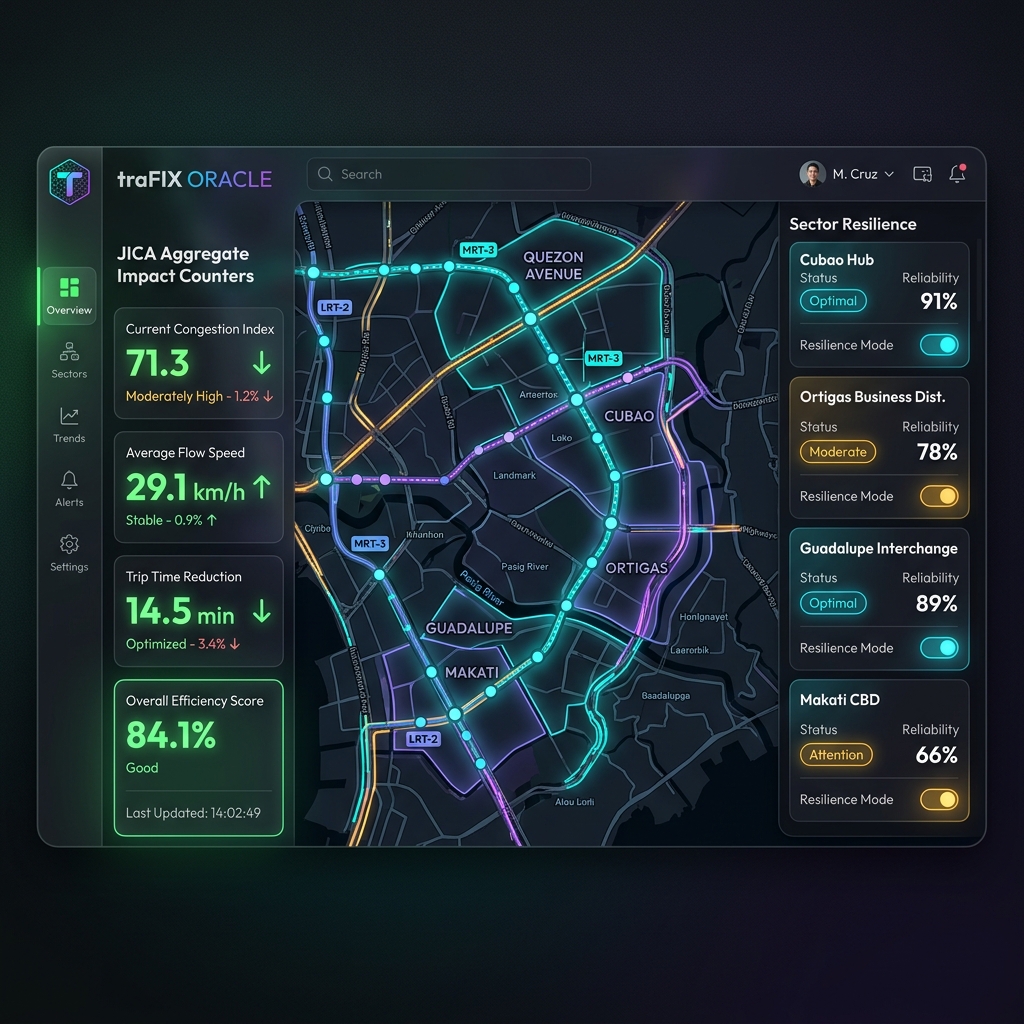
Metro Manila's extreme density has hit a physical asphalt ceiling. With road expansion capped at 0%, traFIX (Flow Intelligence eXchange) is an edge-first, software-defined digital twin that turns gridlock into an optimized transit marketplace — shifting peak commuter demand, maximizing throughput, and restoring lost economic capacity.
Don't Take Our Word For It
Behind Asia's investigation reaches the same conclusion we did — Metro Manila's infrastructure was designed to fail. traFIX is the software-defined answer.
▶ Behind Asia · "Why Metro Manila is Designed to Fail"
Key takeaway: Metro Manila's road network was never designed for the population density it now serves. Physical expansion is impossible. The only solution is software-defined demand optimization — exactly what traFIX delivers.
Why traFIX
Three defining advantages no other platform delivers simultaneously.
The ₱3.5B Crisis
JICA identified Manila's ₱3.5 Billion daily loss as physically unsolvable by road expansion. Zero percent expansion room remains.
Explore the Crisis →Deep-Tech Solution
Simplified circuits slash gate counts, eliminate expensive co-processors, and run cool enough for fanless solar-powered edge deployment — over 20× faster than real-time with zero precision loss.
See the Technology →Deploy Anywhere
From ₱50,000 DIY edge kits for community cooperatives to sovereign national command systems. FaaST scales to any budget.
Deployment Tiers →The Crisis Right Now
The JICA study was the warning. 2026 turned it into an emergency.
Gulf War Fuel Shock
The Strait of Hormuz closure pushed diesel past ₱130/L — making every minute of gridlock 2–3× more expensive than when JICA measured the crisis. The ₱3.5B daily loss is now likely ₱5–6B.
Full Analysis →3–4 Hours Stolen Daily
Filipino commuters lose 3–4 hours every day in transit. Parents leave before their kids wake and return after they sleep. This isn't economics — it's a family crisis.
The Human Cost →15 Minutes = 1 Hour Back
traFIX proves that shifting departure by just 15–20 minutes saves 30–45 min each way. That's 365 hours of family time restored per commuter per year.
How It Works →Secure Your traFIX Pilot Access
Join the Flow Intelligence eXchange. Funding or piloting proposals can be scheduled directly with our regional cooperative coordination team.